Thursday, 6 March 2014

Personalisation/ bespoke does not have to be expensive

http://popsop.com/2013/08/personalisation-its-got-your-name-on-it/

Uses Coke-Cola as its example then goes onto say how cheap and easy it is.... Article:

Fans of Coca-Cola’s personalised bottles can now order their chosen name from Ocado.com—hurrah says I who (admittedly) have been really hoping that the list of names on Coca-Cola’s ‘personalised’ bottles will eventually include mine.
Only a couple of weeks ago, hundreds of customers queued at a local Tesco in Gorton [Manchester for those for who’ve not heard of it] to get their names and nicknames on special custom-made labels. This is the latest phase of the Share a Coke campaign. The brand is touring the country offering an on-site printing service through kiosks and vending machines throughout the summer.
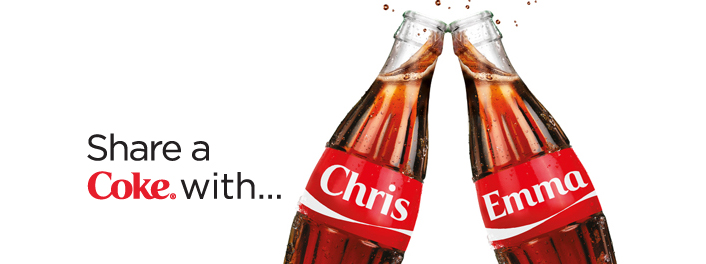
Photo: Personalised bottles, Share a Coke campaign
This is savvy marketing from Coke—the number of column inches a simple packaging tweak has resulted in are testament to that. So too was IRN-BRU’s tongue-in-cheek pop at Coke’s efforts at personalisation, with its own laugh-out-loud Fanny cans.
For packaging specialists, the IRN-BRU stunt highlights just how simple the pack tweak is, making the point that anyone can do what Coke did. It also acts to dispel the urban myth that such personalisation is difficult and costly—the evolution of digital printing has made bespoke mass packaging an achievable reality. With the right specialists, brands really can be braver with their packs.
More importantly however, it illustrates the difference between bespoke generalisation and real personalisation when it comes to packs. Coke’s packs are more about generalisation rather than personalisation, certainly with bottles on shelf. While the 250 named bottles is a major leap in the right direction when it comes to making inroads to personalisation, with the use of available technology, it’s just a first step.
But Coke is right not going the whole hog. The truth is the industry isn’t entirely sure that customers want their grab-and-go buys to have their names on. First of all, they’ve got to get it right. Take the backlash from Starbucks’ approach where they ask people for their names to label their cups. I’ve had my name spelt every which way and it’s a pretty disenchanting experience, and I’m not the only one, people have reported mis-spellings including ‘Arsela’ (Ursula), ‘Manly’ (Molly) and ‘Enema’ (Igmar).
So rather than forcing it on shoppers, brands should give them an option. Notonthehighstreet.com and Moonpig.com have done well because personalising a gift is their core offer. Personalised packaging is only a click away for brands, who could work together with retailers to make this happen through their ecommerce platforms.
So how should brands go about testing the waters? A safe bet would be with seasonal products. Personalised Christmas packaging or Easter eggs would set a strong point of difference in the marketplace. This doesn’t have to be expensive, but shoppers are already on board with paying a little bit extra for something special. Look at one-offs, such as the paint-splashed Absolut bottle, engraving your Apple iPod or even designing your own NIKE ID trainers. These cost slightly more than the typical product, but you know you’re going to be getting something different.
As brands seek to get closer to their target audiences, and seek to create differentiation through added prestige—be that through limited editions or one-offs—truly bespoke personalisation could be about to take centre stage.

New consumer marketing: managing a living demand system. Susan Baker. 2003. Chichester: John Wiley & Sons Ltd

P11
Instead of being the focus of persuasion to buy what producers wished to produce, consumers became the focus of production itself; they could influence to a great extent the nature of products. 

P45
New Consumers are looking for ‘edited choice’; that is, visible guidelines to help them save time and effort.


Smart retailers who understand this particular consumer want are targeting specific groupings of products to appeal to specific segments of New Consumers.

P48
…brand owners and retailers are replacing their ‘one size fits all’ consumer marketing strategies with ones that are more customised and personalised.

P77 expertise


#ebaycollections

eBay Collections is a new way to discover and shop on eBay. Influential curators from the worlds of fashion, lifestyle, electronics and motors have assembled personal collections of the things they love on eBay. And we hand-pick the best collections for you on our eBay Today page.
Find inspiration by browsing their collections and if you like what you see, you can follow them right away.
You can also create your own collection to share with the eBay community. Use your imagination to explore and use the new collection features however you like.
Follow your passion. Follow eBay Collections.
Can follow curators --> not just consumers but curators
Sharing/ community
Expertise
http://portal.ebay.co.uk/collections?_trksid=p2050601.m426&_trkparms=clkid%3D5293613479136510646#fashion

Monday, 3 March 2014

Big idea, Creative idea, creative outcome

BIG IDEA
Consumers as curators
They are becoming more confident. They are more involved in the creation of the outcome. They want a more personalised service

BIG CREATIVE IDEA
Bespoke pattern book service across both physical and digital platforms
Ingredients (visual interpretation): Sharing. Customisation. Filtering. Expertise. Trend. Inspiration. Community. “Physital”
Digital
Website
·         We would offer a range of designers for the customer to choose from so we would be become affiliates, so the sales go back to ROMO for commission (incentive for brands to be a part of our service).
·         Create own profile online- profile questionnaire
·         By using the questionnaire as a filter system, users are presented with a page of recommendations specific to their answers.
·         Those who are more confident will have the opportunity to look further field of these suggestions, and utilise the whole selection of fabrics within the site
·         There will be a ‘save for later’ section where users can like samples and save them in their library. These likes will be recorded on your profile.  This is useful for people who want to decorate step by step- revisit ideas
·         Users can see how popular their swatches are as each will display its number of ‘likes’ e.g twitter re-tweet.
·         Once a swatch has been clicked on, a tab will appear showing users who else has used that swatch recently and what other swatches they have used it with. E.g ASOS or amazon. (see long term for more)
·         On your profile you can see what swatches have been recently viewed by yourself and what swatches are trending via the amount of likes.
·         When users click on a swatch they will be presented with information regarding the fabric composition and a link to the designers website where they can find the collection inspiration if they wish. Not having to view this information if not wanted
The online community (paying members only)
·         For an additional surcharge users can become part of the online community; where they can view each-others books/ libraries, mood boards and view videos (webinars) where interior designers will provide advice and inspiration. (guest speakers will be promoted on the homepage; ‘see how Bob creates a Swedish, Japanese fusion in his home’.
Making a book
·         Select your swatches from your likes library on your profile.
·         From your selected liked swatches, drag a swatch onto the blank pages of the digital pattern book. Users will have the options to change the size of their swatches: small, medium, large and where it is on the page; centre, left, right.
·         The page will also contain an area for the design of the book; do you want tabs on the side, annotations, what colour font etc.
Digital pattern book
·         The book will be instantly available to view via issuu format
·         Books will only be viewable on our website and not for download
·         There will a tab in this section where there will be an opportunity to upgrade to a paying member now to see a surprise selection of samples if the book is purchased physically. We will fill this with design inspiration based on their book. This could include; fabrics they hadn’t thought of, fabrics outside of their filtering system and some inspirational images.
·         If you want this as a physical copy too, there will be a charge whether you are in the online community or not.
·         The digital pattern book will be shopable where users can click on a swatch and be directed to the brand website to buy the fabric (we gain commission as being an affiliate)
Moodboard
·         From creating your digital pattern book you will be able to create a digital moodboard. You will be able to use the samples from your pattern book and also upload images from your computer.
·         These moodboards will be shareable on the online community via your profile. The online community will be able to like your moodboard and comment. These liked moodboards of other users creations will be available to view for inspiration on your profile alongside your library of swatches.
·         You can share your moodboard via social media to raise awareness of the website and gain feedback from peers (see sharing and hyperconnective research)
Look- book
·         There will be lookbooks will be available digitally for all users to view for inspiration.
·         Lookbooks will be trend based and curated by ourselves
·         Users will be able to utilise click through shopping to brand websites to buy direct (could include furniture see point in long term goals)
Competition
·         We will promote competitions to create moodboards based on themes which are on trend which we will dictate. The winner will have their moodboard included in our lookbook tab eg ASOS create a look competition. Homepage promotion of competition and of competition winner. This will direct people to their profile
·         We will recruit new talent via graduates to join our brands for a limited time (exclusive) where users can incorporate the graduate designs into their pattern book
Physical
Physical pattern book
·         Physically the book will have an opening spine where customer can move and shift swatches around e.g. mood boards. Studio Tex example- swatch moodboards
·         Once you are finished with your samples you have the option of sending the samples back and receiving new samples for a discounted rate,  or if you want a new physical book the price remains the same ( incentive/reducing wastage)
·         The physical pattern book will be shopable where users can scan a swatch and be directed to the brand website to buy the fabric (we gain commission as being an affiliate) See Louis Vuitton fashion research example
Long term goals
·         When a user is looking a swatch and it suggests other swatches, there is further opportunity for a furniture collaboration e.g achica; a person who liked this swatch also liked this lamp.
·         3D printing- being able to print the digital pattern book at home for a fee
·         Downloadable app to virtually see fabric in their home e.g. IKEA 3D app
·         Collaboration with fashion designers to create a collection as fashion and interiors become more merged.
·         People can also upload pictures of their new sitting room so people can see what they have done with their chosen swatches (like Houzz) useful for the Jo consumer.

CREATIVE OUTCOMES
1.    Website (talk to Bryony)
-competition homepage, graduate homepage, interior talks homepage
-Profile page with initial questionnaire
2. Branding - logo, business cards, (If we have extra time create a CAD prototype for delivery box)
3. Communication strategy (how to promote website) (recruiting new talent e.g graduates opportunity for them to have their fabrics available to buy for a limited time) (Stall in designers shows)
4. Book mock-up physically/digitally - GET HELP!
5. Make a press release to test the water

6. Look Book mock up digital

Sunday, 2 March 2014

Combining physical with digital experience

Case study:

http://www.wgsn.com/content/report/Retail_and_VM/New_Stores_and_Formats/Chains/2013/March/sport_chek_toronto.html

Consumer confidence/knowledge quotes

Jones, R., 2000. The Big Idea. London: Harper Collins.

p.16
Consumers now have more information and therefore more power than ever before. 

Terry, chief executive of the supermarket chain Tesco, sees exactly the same thing. The shift is happening for a whole range of reasons. "Because in certain areas there's more supply than demand.... Because of education, experience, travel. And because consumers are more aware of their own power and currency.

The internet has accelerated things dramatically. People used to have to trudge around shops, or at least make dozens of phone calls, to compare rival offers: now they can find the best deal for almost anything in just a few minutes on the internet. 

Consumers are now setting the price for what they want to buy.

p.17
This shift means that today's consumer is [not only] indefinitely better informed.

We're entering a world in which buyers actively seek out those things that resonate for them, those things that they can identify with.


Taylor, D., 2003. The brandgym. West Sussex: John Wiley & Sons.

The more emotionally involving a market is, the more important the people dimension becomes, especially when the purchase is expensive and visible to others. P.59

Saturday, 1 March 2014

Customisation/Personalisation quotes from book


Travis, D., 2000. Emotional Branding. California: Prima Publishing.

'We've literally just moved from an age of mass marketing to the age of mass customisation. It's now possible for brand's to communicate with their customers one-to-one.' p.126

In Enterprise One to One (1997), Don Peppers and Martha Rogers write, "Information technology makes three important new capabilities available to businesses. The database allows you to tell your customers apart and remember them individually. Interactivity means the customer can now talk to you. And mass customisation technology enables businesses to customise products and services as a matter of routine". p.126

According to C.K. Prahalad and Venkatram Ramaswamy, writing in the Harvard Business Review (Jan/Feb 2000), there is a difference between customisation and personalisation.

Customisation assumes that the manufactuer will design a product to suit a customer's needs.

With personalisation, however, the customers becomes a co-creator of the content of the experience. More and more customers want to play this role. p.127

Brands can engage in one-to-one marketing to create formidable customer loyalty (paraphrase from p.127)

Amazon Case Study - Having a data history of what interests you, they can actually suggest related books or music. p.128


Building a brand in the mass customisation age is about building a reputation. P.144