Tuesday, 11 March 2014

Whisp- social platform offers private chats for online shopping advice

Whisp lets users chat with friends while they shop online.
Leah Gonzalez
Leah Gonzalez on March 3, 2014. @leahgonz
For many people, shopping is a social activity. People like to shop with their friends and talk with them about potential purchases.
For those who like to buy things via the internet, there’s a new web and mobile app called Whisp that lets users shop online and chat with their friends at the same time.
Whisp lets users shop their favorite designers and stores all in one place and its key feature lets users drag and drop images of products into private chat windows. That way, users can chat with their friends while they shop online.
Whisp-2 Whisp-4
Whisp includes millions of products from top brands like Rag & Bone, APC, and Givency. Users can bookmark their favorites to put them in a private lookbook. They can also chat with friends on the app or on Facebook, and use unique emojis to express themselves while chatting.
Whisp is available for free on the iPad app store.
Check out the introductory video of Whisp b

PHYGITAL (old examples but still relevant!)

http://www.clickz.com/clickz/column/2281397/the-internet-of-things-lets-get-phygital


    Advertising and communications are now crossing over from the virtual to real world and vice versa, through connected objects and devices that allow physical objects to interact with digital platforms.
    The term used to describe this trend is "Phygital" - a convergence of the consumers' physical and digital world.
    This is made possible by the Internet of Things - which refers to connected objects that trigger a physical reaction from a digital action or a physical sensor that when triggered, results in a digital output. It is now possible to embed sensors on most physical objects to allow these objects to "talk" to us via digital interfaces, making the physical world a type of information system itself.
    This symbiotic relationship allows brands to make themselves more tangible to their consumers by connecting their digital presence to an immersive, real-world experience.
    So how can brands and agencies leverage on phygital experiences? Here are some examples:
    1. Amplifying an event
    • The early stages of the Internet of Things revolved primarily around RFID tags. In Israel, Coca-Cola created the Like Machine using RFID tags to bring the virtual world of Facebook into the real world of the Coke Village by allowing guests at the event to share their activities and experiences seamlessly with their Facebook friends.
    • In a role reversal, Brazilian fashion retailer C&A created a store with real-time "likes" counters on its clothes hangers. The like data was taken from C&A's Facebook page where the clothes were listed for people to interact with, allowing customers at the store to see how many people online think that a particular product was a good buy.

    2. Allowing digital participation with a real-world event
    • McDonald's created Pick N Play, an interactive outdoor campaign in Stockholm where consumers could interact with a large billboard using their mobile phones and play games on the billboard to win McDonald's treats and prizes.
    • Coca-Cola as part of project rebrief created a mobile ad that allows users to literally send a Coke and connect with someone on the other side of the world. The Coke gets delivered via a vending machine at the selected location and the random receiver can then respond with a text or video message back to the sender, completing the connection.
    3. Unlocking brand experiences
    • Granata, a pet food company in Germany placed a billboard at a high traffic area where pet owners regularly walk their dogs. The billboard was for Granata Snack Check, which dispenses a small amount of Granata Pet dog food for the dog to eat when the owner checks in at the location via Foursquare.
    • In a similar sampling exercise, BOS Ice Tea allows customers to try free samples from a tweet-activated vending machine. To get a free sample, all you had to do was to tweet a unique brand hashtag.
    • Even advertising agencies have gotten into the act with JWT Brazil creating Drink Time Sheet, which unlocks a fridge of beer once everyone at the agency completes their timesheet.
    4. Product synergies
    • BakerTweet was developed to help busy bakers tell the world that something hot and fresh had just come out of the oven. A simple device that tweets to all the baker's followers on Twitter to tell them that a fresh batch of buns were just ready.
    • Nike built their new Hyperdunk shoes that has sensors and Nike+ technology embedded into the shoes to track a player's every move during games and syncs directly to their iPhones providing statistics and game feedback.
    2013 has been hailed as the breakout year for the Internet of Things at CES. There are many product ideas that can be leveraged by brands to create synergistic brand experiences that truly add value to their consumers in a way that only the brand can. Take Pintofeed, a mobile app connected to a food dispensing machine that allows you to feed your pets remotely without always having to rush home. Sensors on the machine confirm that your pet is fed and the device also helps you monitor and control your pet's food intake and even compare it to the national average. This is a digital/physical utility that truly solves a consumer's need for pet owners. Now just imagine if a pet food brand had created this.
    How do brands and agencies go about creating phygital experiences?
    The most important thing to know is that all of what we are referring to now goes beyond traditional advertising and communications. To be able to create these phygital experiences, agencies need to move away from an advertising output to creating actual physical objects and installations that can be deployed at the right locations to facilitate these interactions. This helps extend the real value of a truly great idea because it supports the notion that if something does not yet exist, we can just build it, both digitally (e.g., mobile interface) or physically (an installation).
    This requires agencies to adopt a technology and innovation model and a maker's culture that moves beyondart and copy to include software and hardware engineering and the knowledge of how to use open source hardware and popular microcontrollers such as Arduino and the Raspberry Pi processor.
    With the advent of more devices such as Google Glass, it's just a matter of time before we see, feel, and act with our physical and digital world as one.
    More and more objects are being embedded with sensors allowing us to communicate with them. In addition, more people are also allowing themselves to be embedded with sensors - some in our phone and some on objects that we wear like the Nike Fuelband and Jawbone Up Wristband that allow our physical lives to be transmitted as packets of data in which can be used to communicate with physical objects. The opportunities are boundless for brands to leverage on such technology, data, and behavior and it will be exciting to see what comes out next.

    Testing confidence

    Not really relevant anymore but if we happen to need ideas...
    http://www.mindtools.com/pages/article/newTCS_84.htm
    http://www.allthetests.com/quiz16/quiz/1129850543/Looking-at-Your-self-confidenceself-consciousness
    http://www.guidetopsychology.com/testing.htm#1

    Saturday, 8 March 2014

    Physical to digital examples

    1. Finger reader (also haptics involved)
    A ring built by MIT is able to quickly scan and read text, turning it into audio as your finger traces the page.

    With the visually impaired and translation assistance in mind, FingerReader is designed to help read printed text.
    As wearers scan individual lines with their finger, a camera working in tandem with internal algorithms detects words and reads them aloud. The device is able to tell when a user's finger strays and gently provides haptic feedback to physically nudge the hand back into place, keeping a straight scanning motion. Haptic cues are also provided according to layout, for example, at the start or end of a line.

    MIT's Fluid Interfaces Group believes the interaction between humans and tech has not changed significantly since the PC was first invented, and sets the promotion of more natural and integrated experiences as its goal.
    https://www.prote.in/en/feed/2014/02/fingerreader

    2. The echo project
    To mark the spring release of Khaled Hosseini’s new book, And The Mountains Echoed, Penguin Books have partnered with Dare Toronto to launch The Echo Project: a sprawling, page-by-page web companion to the novel.   

    Inviting several high profile artists and authors (including Hosseini himself) to choose and interpret one of the book’s 402 pages, the project is an impressive melting pot of interactivity. Images, historical video, real-time weather data and even Afghan recipes all serve to immerse readers in the book’s themes more thoroughly.   

    Like LEO The Maker Prince, book publishers are continually using advances in technology to expand the reading experience. And, in a nifty move, some of the project’s 402 pages have been left blank, allowing readers to contribute their own interpretations for consideration.

    https://www.prote.in/en/feed/2014/03/the-echo-project

    3. Even our money...
    With the rise of things like Bitcoin and contactless payments it seems that what we traditionally think of as 'money' is in recession.
    https://www.prote.in/en/feed/2014/03/protein-forum-the-future-of-money-take-note

    4. Marc Jacob Tweet shop
    With plastic notes potentially being introduced in 2016 and the Bitcoin becoming an ever more viable means of transaction, the banks must be fearful of the news that a new Marc Jacobs pop up shop has taken the inevitable step of placing the value of currency in hashtags. No money will change hands at the Daisy Marc Jacobs Tweet Shop (open during New York Fashion Week), where the use of #MJDaisyChain can earn you Marc Jacobs fashion items and accessories.
    https://www.prote.in/en/feed/2014/01/daisy-marc-jacobs-tweet-shop

    5. Retrosuperfuture
    Continuing the trend towards merging the physical and digital world, Italian sunglasses maestrosRetrosuperfuture have opened a phy-gital store, which cleverly combines sleek woodwork and clandestine digital offerings.   

    It’s the brands first US store, and lives up to its namesake with interiors that are both retro and futuristic, in a minimalist, industrial space with exposed brick and wooden display cases. But what distinguishes it from your average on-trend and much-hyped store, are the hidden iPads, carefully encased in the store’s beautifully crafted drawers, which enable customers to scroll through the brand’s stock.  
    https://www.prote.in/en/feed/2014/02/retrosuperfuture

    6. Giant physical  Pinterest board
    Caribou Coffee partnered up with ad agency Colle + McVoy to recreate Pinterest’s digital board in real life, marking an interesting publicity stunt that weaves in creativity and entertainment. This five-storey Pinterest board is raised in the Mall of America in Minnesota, and allows passersby to pin live posts up to the board using their smartphones.
    http://www.psfk.com/2014/02/giant-pinterest-board-caribou-coffee.html#!zjuBT

    Digital to physical examples

    1. Wikipedia book!
    Digital age translated into the Guttenburg printing press age
    In preparation for this year's Wikimania conference, a small team of developers are raising money to print a physical copy of the open source online encyclopaedia, Wikipedia. 

    The project would see 1,000 printed books at about 1,200 pages each, essentially bringing the collective crowdsourced knowledge of the internet to life in physical form.

    Each volume will feature continuous page numbers meaning the last article could sit somewhere around page 1,193,014. It would take a 10 metre long, 2.5 metre high book case to store all of the works. 

    https://www.prote.in/en/feed/2014/02/wikipedia-books-project

    2. Tx.to
    Enhancements in technology may have the potential to render books and records unnecessary baggage, bringing a shiver to the spine of bookshelf lovers everywhere, but with the trend in converting the digital to the physical showing no signs of slowing down, we may just rediscover new life in the old furniture yet...

    Now two French entrepreneurs have created an online service that documents your text conversation and prints it onto a good old-fashioned physical scroll called Tx.to. As well as giving you the opportunity to re-read these exchanges in a physical format, the Tx.to service also offers users a chance to gain some insight into their text relationship. The Tx.to cloud will safely store messages, and using your data, you can research statistics on the history of your conversation with your partner; picking out things like the most used words or periods of highest activity. 
    https://www.prote.in/en/feed/2014/03/tx-to

    3. Vine flip
    It feels like, at the moment, it's hard to look anywhere without watching a looping six-second video, and it's all thanks to new social media platform, Vine. We've already looked at a music video made from crowdsourced Vines, and now comes Vine Flip, an experiment in 'slowing down' the technology. By submitting recorded videos Vine Flip prints out the frames as a physical flip book that is then sent to the user. 

    Much like the Vine equivalent of the Instagram printer, Instaprint, this project looks at bringing digital technologies into the physical realm by bridging old and new technologies.
    https://www.prote.in/en/feed/2013/04/vine-flip

    4. Lebox
    Created by Mathieu Lecoupeur and Soy Phompraseuth, LEBLOX is an app that allows you to digitally build miniature, pixelated, Perler-style models that are then 3D-printed and delivered to your door. The creation element of the process uses augmented reality to give you a realistic impression of what your 3D design will look like, in its exact size and proportion. Designs that you particularly proud of can be shared with the LEBLOX community and printed by other users. 
    https://www.prote.in/en/feed/2014/02/leblox

    5. NailSnap
    NailSnaps is the latest app following the trend of bringing Instagram photos into the real world as tangible objects, in this case as customized nail polish stickers. The project is currently raising funds on Kickstarter to finalize the app and print production facilities.
    Within the app, users can decide how the design will appear, using either the entire image spread across the nails, or selecting specific sections of the image for each nail. After submitting a design, the stickers are printed and shipped from the manufacturing facility in Los Angeles. Eventually, the founders hope to expand the concept by creating a marketplace where popular designs can be sold to other users.
    http://www.psfk.com/2014/03/favorite-instagram-pics-transformed-into-nail-art.html#!zq1g3

    6. Facebook chat books
    In this day and age, sometimes the great conversations in a friendship or relationship happen over Facebook chat. Unfortunately, Facebook chat is also an ephemeral and finicky medium, prone to blip-outs and lost data, not to mention the possibility that Facebook could one day go under entirely. Email, too, is not forever. Enter Memeoirs, the book-making service based in Povo, Italy that can write the epistolary novel of your online life.
    The interface for Memeoirs is incredibly simple; you can simply connect your Facebook account to the service and select the person whose conversations with you you’d like included in the book. The process is automated, so no human will pry into your love letters (the company has taken on couples as its target audience, with endearing success stories on their website of how their clients fell in love over email).
    http://www.psfk.com/2014/03/a-startup-is-printing-customized-books-of-personal-facebook-interactions.html#!zF93U

    Friday, 7 March 2014

    Thursday, 6 March 2014

    Personalisation/ bespoke does not have to be expensive

    http://popsop.com/2013/08/personalisation-its-got-your-name-on-it/

    Uses Coke-Cola as its example then goes onto say how cheap and easy it is.... Article:

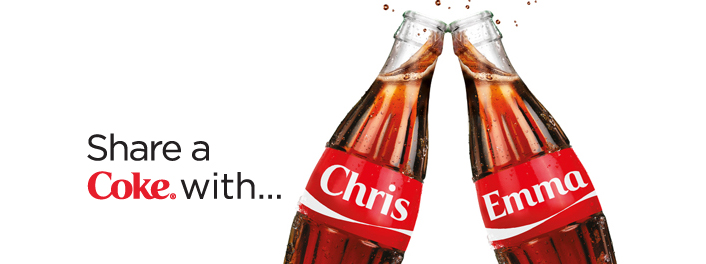
    Fans of Coca-Cola’s personalised bottles can now order their chosen name from Ocado.com—hurrah says I who (admittedly) have been really hoping that the list of names on Coca-Cola’s ‘personalised’ bottles will eventually include mine.
    Only a couple of weeks ago, hundreds of customers queued at a local Tesco in Gorton [Manchester for those for who’ve not heard of it] to get their names and nicknames on special custom-made labels. This is the latest phase of the Share a Coke campaign. The brand is touring the country offering an on-site printing service through kiosks and vending machines throughout the summer.
    Photo: Personalised bottles, Share a Coke campaign
    Photo: Personalised bottles, Share a Coke campaign
    This is savvy marketing from Coke—the number of column inches a simple packaging tweak has resulted in are testament to that. So too was IRN-BRU’s tongue-in-cheek pop at Coke’s efforts at personalisation, with its own laugh-out-loud Fanny cans.
    For packaging specialists, the IRN-BRU stunt highlights just how simple the pack tweak is, making the point that anyone can do what Coke did. It also acts to dispel the urban myth that such personalisation is difficult and costly—the evolution of digital printing has made bespoke mass packaging an achievable reality. With the right specialists, brands really can be braver with their packs.
    More importantly however, it illustrates the difference between bespoke generalisation and real personalisation when it comes to packs. Coke’s packs are more about generalisation rather than personalisation, certainly with bottles on shelf. While the 250 named bottles is a major leap in the right direction when it comes to making inroads to personalisation, with the use of available technology, it’s just a first step.
    But Coke is right not going the whole hog. The truth is the industry isn’t entirely sure that customers want their grab-and-go buys to have their names on. First of all, they’ve got to get it right. Take the backlash from Starbucks’ approach where they ask people for their names to label their cups. I’ve had my name spelt every which way and it’s a pretty disenchanting experience, and I’m not the only one, people have reported mis-spellings including ‘Arsela’ (Ursula), ‘Manly’ (Molly) and ‘Enema’ (Igmar).
    So rather than forcing it on shoppers, brands should give them an option. Notonthehighstreet.com and Moonpig.com have done well because personalising a gift is their core offer. Personalised packaging is only a click away for brands, who could work together with retailers to make this happen through their ecommerce platforms.
    So how should brands go about testing the waters? A safe bet would be with seasonal products. Personalised Christmas packaging or Easter eggs would set a strong point of difference in the marketplace. This doesn’t have to be expensive, but shoppers are already on board with paying a little bit extra for something special. Look at one-offs, such as the paint-splashed Absolut bottle, engraving your Apple iPod or even designing your own NIKE ID trainers. These cost slightly more than the typical product, but you know you’re going to be getting something different.
    As brands seek to get closer to their target audiences, and seek to create differentiation through added prestige—be that through limited editions or one-offs—truly bespoke personalisation could be about to take centre stage.